
A Look Back at Tracy Sayre's Tenure as Moonshot Initiative Co-Executive Director

Moonshot Initiative co-founder Tracy Sayre has announced that she is stepping down as co-executive director. Below, in this look back at Tracy's time at Moonshot, read her personal account of her journey to help build this organization.

Eight years ago, I saw that my good friend Katrina Medoff had posted on Facebook to gauge interest in a short film challenge with women in every role of production. When I read her post, I thought it was a cool idea, but I was already busy producing films and running a company for writers. Oh, and I was 3 months pregnant.
Still, I went to bed thinking about this idea and checked her post first thing next morning. I was amazed to see that there were already over 300 responses! I got emotional as I read through people’s comments about how much they wanted a chance to work with other women on set after so many years of working on male-dominated crews. I was so inspired that I called Katrina up to see if she needed a partner in this undertaking.
And that was how Moonshot Initiative began – although we called it Women’s Weekend Film Challenge at the time.

I figured it would be a fun activity to do with my friend before my baby was due. Little did I know, the next two months we would be up late into the evening, figuring out how to put 188 women together onto nine crews, making sure that between all these crew members, everyone had enough equipment, cars, and filming locations to make a short film. It was one massive puzzle, but fortunately, Katrina and I love puzzles. We had absolutely no money. We were doing all of this work after our day jobs and on weekends.

Less than two months after that Facebook post, we were producing nine short films at once all across New York City. I remember visiting seven of our nine sets on one of the shoot dates. It took forever to get from one set to the next because I could only afford to take the subway and the sets were all across the city. But it was worth it. It was incredible watching these teams come together and make something real after so many weeks of what felt like theoretical planning.

A week later, we premiered the nine short films to a packed audience. It felt like a family reunion. All of the participants kept coming up to the us and begging us to do this again. And we listened.

Again, we had no idea how much work we were signing up for. We got hundreds of applications and we had to make sure that each crew had everything they needed amongst them since we had no money. In the middle of all this planning, I had my baby! We got back to work five days after the baby came. I would not recommend this to anyone else, as a work-life balance is crucial. I was just so consumed with making the best film challenge possible that I had a hard time letting go.


Over the next two years, each iteration of the challenge got more robust. We started getting equipment donated, which meant we needed to get insurance, which meant we needed to open a bank account, which meant we needed to create a partnership, which meant we needed to apply for a fiscal sponsorship for those donations to be tax-deductible, and so on. We started fundraising year-round for these unexpected costs. We spoke on every podcast that would have us. We built a website. And we were still working other day jobs because we couldn’t afford to pay ourselves.


And then we thought, hey, this is not hard enough…let’s offer this program in LA! The truth is, we were meeting so many people who were moving back and forth between the coasts that we realized building a community in LA would help our NYC community as well.
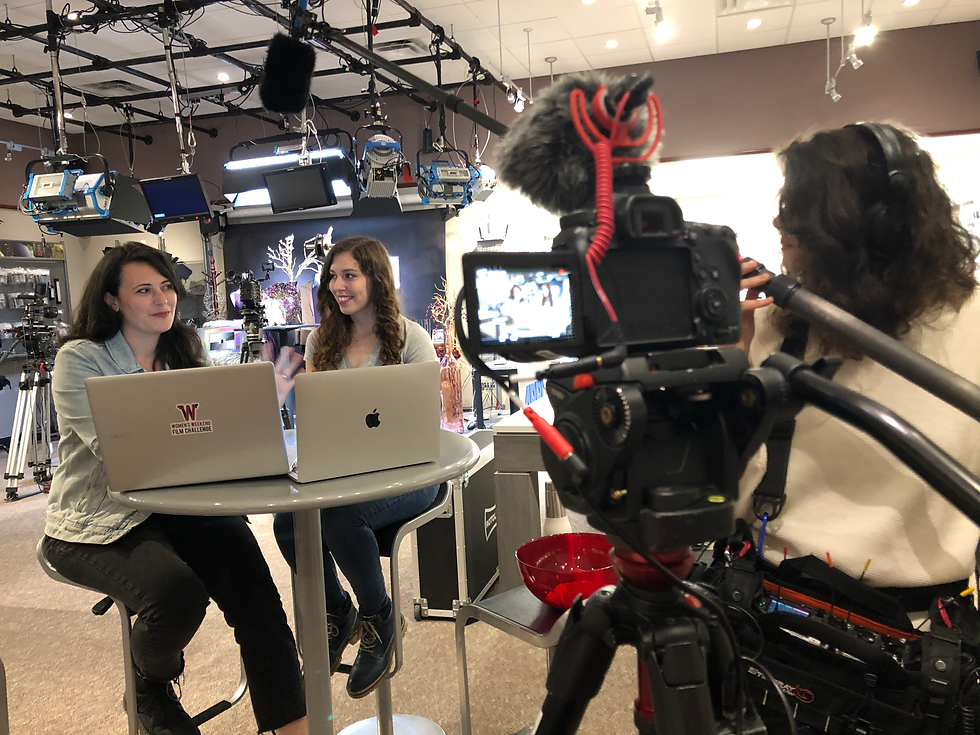
Again, with no money or connections, we opened up applications for a film challenge in LA. Over 500 people applied! We couldn’t believe the response. After months of planning, we flew to the West Coast for a month to run the challenge in February 2020. For the first time, we had to deal with location permits, more equipment than ever before, and LA traffic. We were on "Good Day LA," our first live news segment. At the same time, we kept hearing about this strange, far-off Coronavirus. But we had so much work on our hands that international news barely registered.

We hosted a screening for our LA films at ArcLight Hollywood on March 5, 2020. Over 400 people came to watch the films we made. As soon as we could take a breath, the news hit us: the world was shutting down.

We flew back to NYC, and I found that the daycares and playgrounds were closed. My husband and I decided to stay at my parents' house for a few weeks because it was impossible to get any work done with a 2-year-old in a one-bedroom apartment. Little did we know this was not going to be a short break.
Katrina and I commiserate over the fact that we couldn’t host another film challenge for the foreseeable future. But then it hit us: If we couldn’t be on set, there were thousands of filmmakers who couldn’t either. Everyone was looking for support and motivation during this time. We wrote to 50 directors we admired to ask if they’d like to share some career advice with our community, and one of them got back to us – thank you, Susan Johnson of "To All the Boys I've Loved Before"! This was the beginning of April 2020 before everyone was using Zoom, and we had to figure out how to configure our sessions and how to use the platform. Over 200 people attended that first session with Susan and we knew we were on to something.
We began hosting these Zoom sessions every week, and the attendance kept growing. With some workshops, we had over 1,000 audience members! We were exhausted; planning, marketing and booking guests is a full-time endeavor, not to mention the emotional toll of the pandemic. But we kept getting messages that these workshops helped our community stay motivated and hopeful during this impossible time. We were also able to pay ourselves a modest salary for the first time because so many people were donating small amounts for the workshops.

One thing that became clear during these workshops: so many people wanted to know how to get into a writers' room, or become a showrunner, or sell a script. It was clear our community had the talent and materials, but they didn’t have the connections. And we were gaining the connections through the workshop series. This is when we started designing the Moonshot Pilot Accelerator.
Over 700 people applied the first time we offered this program. We could not believe the interest. But we also couldn’t believe how much work it took to read over 700 scripts. We had assembled a team of volunteers to help, but this was also our first time doing an accelerator and we wanted to make sure we personally reviewed every script. By the time we selected the 8 fellows for our program, the people who would get to pitch to over 20 major studios and production companies, I felt cross-eyed from reading so much. Oh, and I had moved to a new city and was pregnant again!

This was when the work-life balance issue caught up with me. My body basically shut down after having my second kid. Katrina was so supportive as I made my slow recovery, but we struggled. We ran out of money, we had to postpone the film challenge, our schedule was off, and I didn’t realize how hard it would be to work with two kids and no daycare as COVID closures continued.
But if you’ve gotten this far in the post, you’ll know that our friendship gets us through the impossible. We brought a film challenge back in 2022, and it was bigger than ever. We also continued offering the accelerators and added a feature version of it. We continued to offer workshops. We developed a membership for people who wanted to support our work and gain access to the archive and an online community. We rebranded from Women’s Weekend Film Challenge to Moonshot Initiative because we needed a name to encompass our wider vision and our gender-expansive community. We moved from a fiscal sponsorship to a nonprofit. We formed a nonprofit board. We started getting grants. We expanded our team. We did a lot.

And now, I feel like the organization is strong enough where I can step away and it will still thrive. I moved to the Hudson Valley during the pandemic, and I’ve spent most of the time since then on Zoom. I moved here because there’s a thriving, progressive arts community and I want to be a part of it. This was such a hard decision, but I knew it was the right one.

Katrina and I built something incredible together. We never waited around for permission or help. Instead, we pushed ahead, knowing that we could do anything we put our minds to. And this transition has been something we’ve put our minds to. For the last six months, Katrina and I have been working on how she and Kendall, our programs manager, can take over my workload. It’s hard letting go, but I know Katrina is going to take Moonshot to incredible heights and I’m going to be cheering her on from the sidelines.

I can’t end this post without asking for your help with this transition. Katrina has so much on her shoulders now, and knowing the community will rise up to lift some of that burden will help in more ways than one. Moonshot had a scrappy beginning, but now thousands of people count on Moonshot for education, access and opportunities. Please send Katrina some support by making a tax-deductible donation and a comment of support.


Comments